Mathematicians Dror Bar-Natan and Roland van der Veen have invented a knot invariant that breaks a century-old trade-off between computational feasibility and discriminatory power. Their method assigns each knot a colorful hexagonal "QR code" — a symmetric, snowflake-like pattern that can distinguish knots with hundreds of crossings, far beyond what existing invariants can handle. Most knot invariants fail at 15-20 crossings; this one scales to 300 crossings routinely and has been tested past 600. The output's visual richness suggests deep structural properties of knots that mathematicians have not yet understood. The work combines representation theory with algorithmic efficiency, opening new territory in knot theory where computation was previously impossible.
Knot theory studies closed loops in three-dimensional space. Two knots may look different but be equivalent under continuous deformation. Invariants are mathematical tools that assign values to knots; different values prove non-equivalence, but identical values leave ambiguity. Strong invariants were historically intractable to compute.
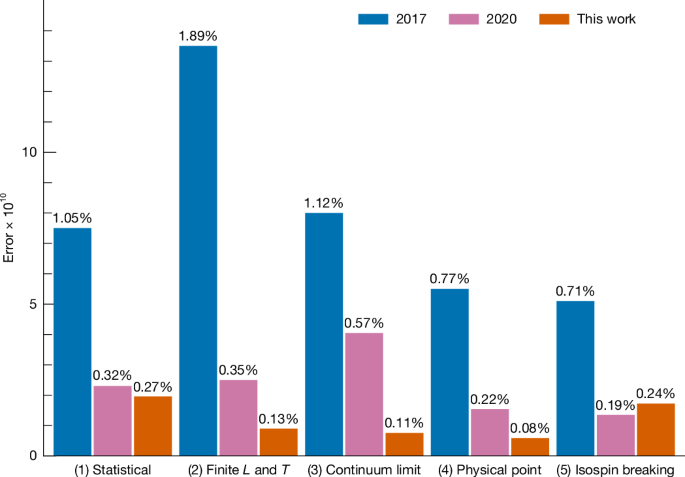
The two-decade discrepancy between measured and predicted values of the muon's anomalous magnetic moment has collapsed under a new lattice QCD calculation. Researchers at Penn State and collaborating institutions used a hybrid method combining experimental data at low energies with lattice simulations at higher energies, achieving 0.48% precision on the hadronic vacuum polarization contribution. Their result brings the Standard Model prediction into agreement with Fermilab's Muon g-2 measurement within 0.5 standard deviations. The 4.2-sigma tension that hinted at a fifth force or new physics has dissolved. The calculation validates the Standard Model to eleven digits and removes one of particle physics' most tantalizing clues for beyond-Standard-Model physics.
The muon g-2 experiment measures how muons wobble in magnetic fields. A 2006 Brookhaven result and 2023 Fermilab confirmation showed a 4.2-sigma deviation from theory, suggesting possible new particles or forces. The uncertainty came from hadronic vacuum polarization — strong interaction effects that are difficult to calculate from first principles.
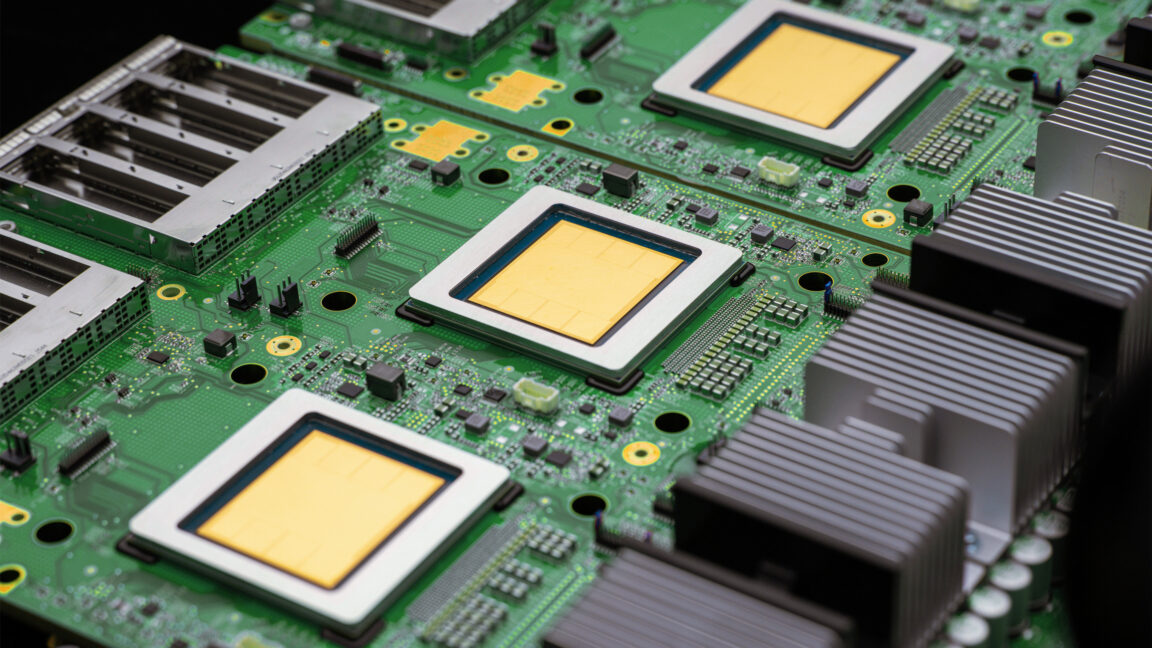
Google has split its eighth-generation TPU into two specialized chips: TPU 8t for training and TPU 8i for inference. The training chip scales to 9600 chips per pod with two petabytes of shared memory, delivering 121 EFlops of FP4 compute — nearly triple the previous generation. Google claims linear scalability to one million chips. The inference chip carries 384 MB of on-chip SRAM to accelerate long-context models and runs in 1152-chip pods. Both use Google's custom Axion ARM CPUs in a 2:1 ratio, replacing x86 hosts. The company reports 97% "goodpute" efficiency and double the performance-per-watt of Ironwood. The bifurcation reflects a bet that training and inference workloads have diverged enough to warrant separate hardware optimizations.
TPUs are Google's custom AI accelerators, deployed in their cloud infrastructure as an alternative to Nvidia GPUs. Previous generations used identical hardware for training and inference. The 'agentic era' refers to AI systems that perform multi-step tasks autonomously rather than single-turn responses.
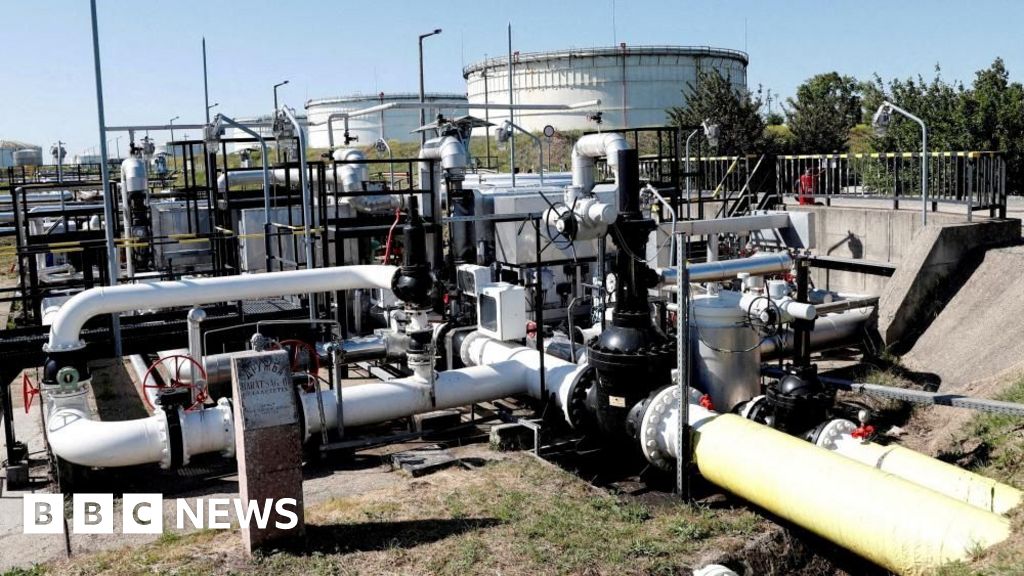
Ukraine has resumed pumping Russian oil through the Druzhba pipeline to Hungary and Slovakia, unlocking a €90 billion EU loan that Viktor Orbán had blocked since February. The Hungarian leader had tied the loan to restored oil flows, claiming Ukraine imposed an 'oil blockade.' His election defeat last Sunday removed the political obstacle; his successor Péter Magyar seeks improved EU relations. Two-thirds of the loan funds Ukrainian defense. The pipeline restart and loan approval came within hours on Wednesday, though actual fund disbursement may take weeks. The episode illustrates how EU financial support for Ukraine remains hostage to member state leverage over unrelated commercial interests.
The Druzhba pipeline has carried Russian oil to Central Europe since Soviet times. Hungary and Slovakia depend on it heavily. Orbán's 16-year rule ended April 19, 2026. The EU loan was agreed December 2025 but required unanimous approval; Hungary's veto was the final barrier.
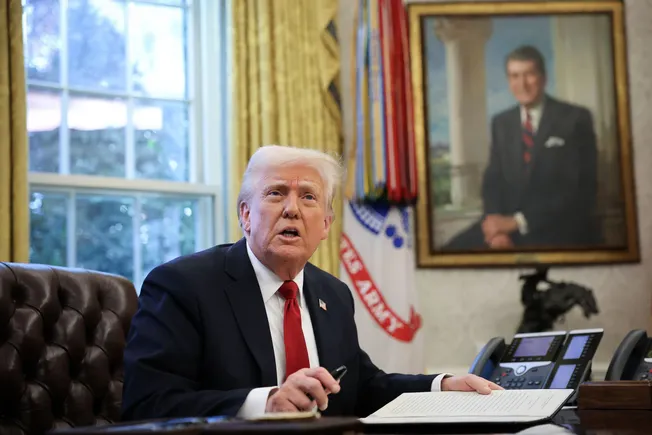
A coalition including the AAUP and NADOHE sued Monday over a March executive order requiring federal contractors to certify they will not engage in 'racially discriminatory DEI activities.' The groups argue the definition sweeps in protected speech and lawful diversity initiatives, including faculty research on racial health disparities and courses in Black or Latino studies. Federal agencies must insert the clause into contracts by April 25. The plaintiffs fear forced choice between abandoning academic work and losing federal funding. This is the third anti-DEI lawsuit from these groups since January. The order frames DEI as causing 'inefficiencies, waste, and abuse' in government contracting.
The AAUP (American Association of University Professors) and NADOHE (National Association of Diversity Officers in Higher Education) previously sued over two earlier Trump orders canceling 'equity-related' grants and requiring non-discrimination certifications. The March order specifically targets federal contractors, which includes most research universities.
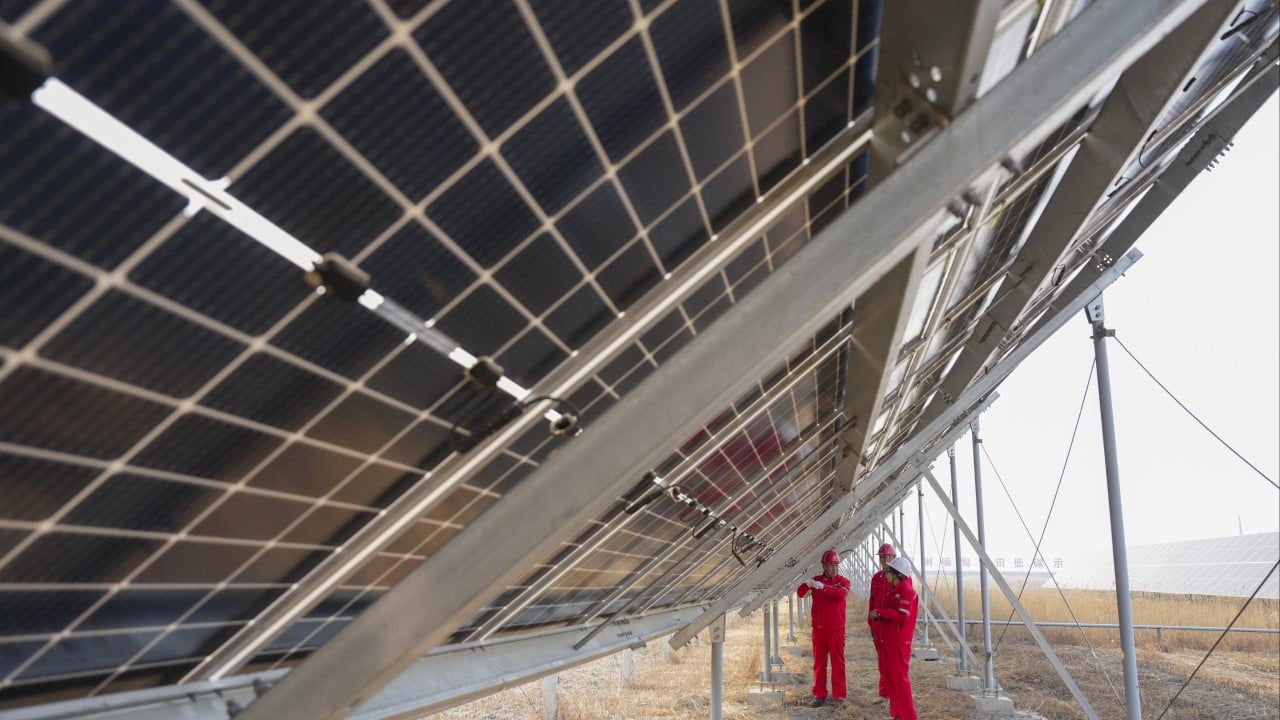
The Chinese Academy of Sciences has deployed what it calls the world's first 'panoramic' carbon accounting system, an AI model that shifts emissions responsibility from producers to consumers. For 2022, it calculated China's emissions 17.7% below UN figures while raising US emissions 15.2% above conventional estimates. The model, developed at the Shanghai Advanced Research Institute, weights consumption more heavily than production, reducing exporter responsibility. Beijing presents this as correcting an inequitable global framework that blames manufacturing nations for emissions driven by Western consumption. The timing coincides with intensifying US-China climate diplomacy and trade disputes over clean energy subsidies.
Conventional carbon accounting attributes emissions to the country where CO2 is physically released. Consumption-based accounting traces emissions through supply chains to the final consumer. China is the world's largest emitter by production but a major exporter of carbon-intensive goods.
The White House 2027 budget requests an 87% funding increase for plutonium pit production at the Savannah River Site and 83% more at Los Alamos, aiming to double output from 30 to 60 pits annually. A leaked NNSA memo from February outlines plans for 'enhancing American nuclear dominance' and prototyping new warhead designs. Critics note approximately 15,000 existing pits are stored in Texas, with independent studies suggesting 85-100 year lifespans. The Union of Concerned Scientists argues the push is not about replacing aging stockpiles but building new weapon types. The same budget cuts nearly $400 million from nuclear environmental cleanup programs.
Plutonium pits are the fissile cores that initiate nuclear explosions. US production ceased in 1992 after the Cold War. The NNSA has sought to resume production since the early 2000s, citing aging concerns, though scientific assessments have generally found existing pits remain viable for decades.
Judge Denise J. Casper of the US District Court for Massachusetts issued a preliminary injunction Tuesday blocking multiple federal restrictions on renewable energy development. The ruling applies to trade groups representing wind and solar developers, expanding a December decision that had covered only offshore wind developers and coastal states. The challenged rules from the Department of Interior, Army Corps of Engineers, and Fish and Wildlife Service imposed extra review layers, unusual evaluation standards, and resource access restrictions singling out renewables. Casper found most lacked justification beyond implementing a Trump executive order, making them 'arbitrary and capricious' under the APA. Two rules survived: the Corps of Engineers and Interior Department policies that attempted to justify restrictions by citing renewable energy's greater land use per unit output.
The Administrative Procedure Act governs how federal agencies make regulations, requiring reasoned decision-making and prohibiting arbitrary or capricious actions. The December 2025 ruling by a different judge in the same court found the offshore wind withdrawal violated this standard.
A Nature paper by researchers at OpenAI and Georgia Tech identifies a structural incentive problem in LLM evaluation. Standard accuracy-based benchmarks reward models for guessing over admitting uncertainty, even when the model lacks reliable knowledge. The authors prove that next-word prediction creates unavoidable errors for facts appearing rarely in training data, while recurring patterns like grammar are learned reliably. Current reinforcement learning from human feedback and retrieval methods do not fix this. They propose 'open-rubric' evaluations that explicitly state error penalties, allowing models to calibrate abstention to stated stakes. The work reframes hallucination not as a technical bug but as a misalignment between evaluation metrics and desired behavior.
Hallucinations are confident false statements generated by language models. Prior work focused on technical mitigations like retrieval-augmented generation or consistency checking. This paper argues the root cause is evaluation design that punishes 'I don't know' responses equally to wrong answers.
The China Manned Space Agency has selected Muhammad Zeeshan Ali and Khurram Daud as Pakistan's first astronaut candidates. One will fly as a payload specialist to the Tiangong space station this year, becoming the first foreign national aboard the Chinese station. The selection follows a 2023 agreement between Beijing and Islamabad. Chinese state media framed the mission as demonstrating 'the Chinese government's open attitude of sharing the fruit of its space development with the international community.' The move contrasts with NASA's ISS partnerships, which exclude China due to US legislative restrictions. Pakistan has no indigenous human spaceflight capability; the mission represents full dependency on Chinese infrastructure and training.
Tiangong is China's modular space station, operational since 2022 with a crew of three. China has sought international partners for its space program as counterprogramming to the US-led ISS consortium. Pakistan is a long-time Chinese ally with deepening military and economic ties.