The National Science Library of the Chinese Academy of Sciences (中科院) has stopped publishing its influential journal ranking after more than 20 years, leaving Chinese universities uncertain how to evaluate research quality. The CAS Journal Partition Table had become central to hiring, funding, and promotion decisions across Chinese academia. Some of the former CAS team have launched a private replacement called Xinrui Scholar, using the same methodology. Scholars question whether this new index can be truly independent, and whether China might finally move beyond journal metrics toward more substantive evaluation of research quality.
The CAS ranking grouped journals into discipline categories and four tiers based on citation metrics. It was originally designed to help Chinese researchers identify reputable international journals, but over time became a rigid gatekeeping mechanism for academic careers. Critics noted its lack of transparency and occasional surprising downgrades of established journals.
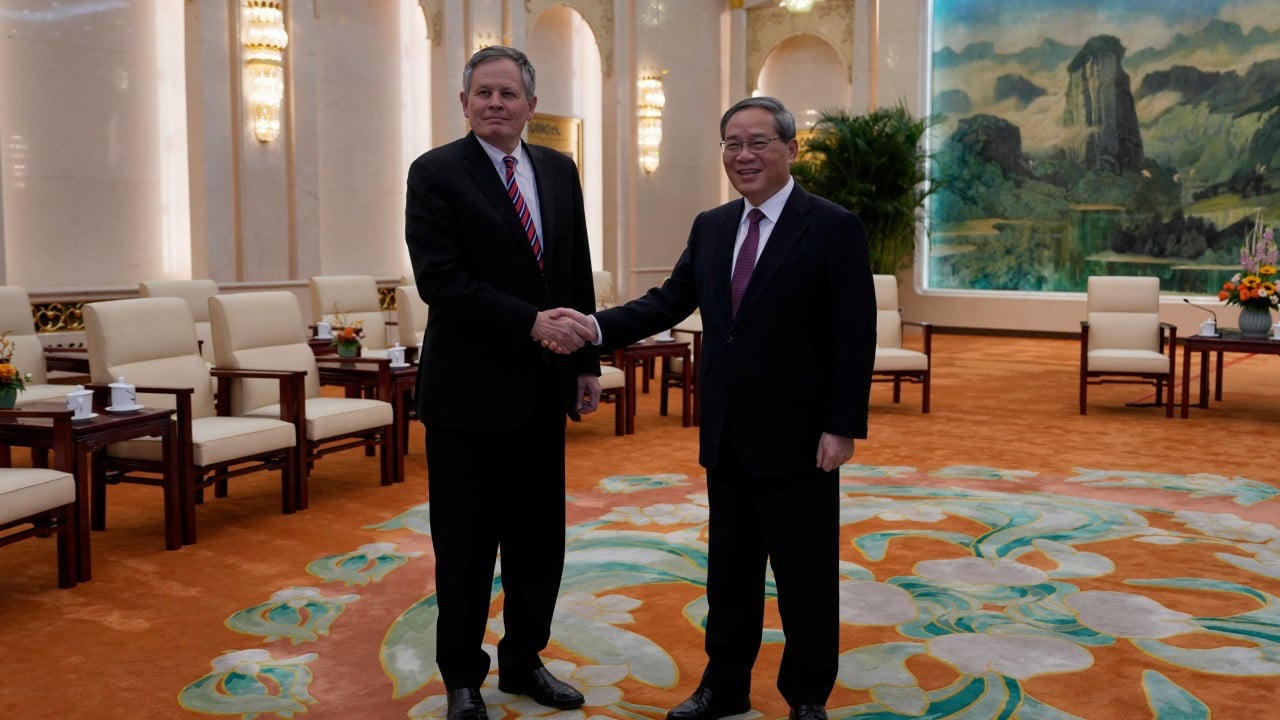
Senator Steve Daines, a Republican from Montana and close Trump ally, will lead a bipartisan delegation to China beginning May 1, with stops in Shanghai and Beijing. The visit comes as Washington increases pressure on China over trade, technology competition, and Beijing's ties to Iran, ahead of a leaders' summit scheduled for May 14-15. Daines has said the trip will focus on China's infrastructure and innovation ecosystem, including a ride on the high-speed rail network. Several delegation members will be visiting mainland China for the first time.
Daines is a senior member of the Senate Foreign Affairs Committee. His visit represents a rare bipartisan congressional engagement with China at a moment of heightened tension. The May 14-15 summit will be a closely watched meeting between US and Chinese leadership.
The US Navy plans to deploy thousands of uncrewed surface vessels across the Indo-Pacific by 2030, a strategy Taiwanese analysts welcome as a potential complication for Beijing's military planning. Captain Garrett Miller said the Navy expects more than 30 medium uncrewed surface vessels alongside thousands of smaller drone boats. Cheap, expendable drones could force the People's Liberation Army to track and engage far more targets, raising the cost of any blockade or attack scenario. However, analysts note geographic and industrial constraints may limit how much capacity actually reaches the Taiwan Strait.
The 'hellscape' concept involves overwhelming adversaries with large numbers of cheap, attritable drones. The US is racing to match capabilities demonstrated by Ukraine and Iran, which have used inexpensive drones to neutralize far more expensive conventional weapons.
American academia suffers from a gerontocracy problem worse than commonly acknowledged, argues Samuel Moyn. The median age of tenured faculty has risen steadily while the pipeline for younger scholars narrows. This demographic skew shapes research priorities, pedagogical approaches, and institutional resistance to change. Moyn contends that the profession's failure to renew itself generationally threatens both intellectual vitality and the legitimacy of higher education in a society increasingly skeptical of its value.
Samuel Moyn is a professor of law and history at Yale University. His argument touches on structural barriers facing early-career academics, including the collapse of tenure-track positions and the rise of contingent labor in universities.
China has launched a bond-market-connect scheme with Brazil, marking its first such link with an emerging market. These schemes allow investors to bypass capital-flow controls when trading across borders. China now maintains at least five offshore capital-market connects on three continents: Hong Kong (the largest conduit, with 212 billion yuan daily turnover), Singapore (ETF connectivity for ASEAN investment), and others. The Brazil link signals Beijing's push to internationalize the yuan and reduce dependence on Western financial infrastructure.
Connect schemes emerged after 2014 as a controlled way to open China's capital markets. Hong Kong remains the primary gateway, but Singapore and now Brazil offer alternative channels. These links matter for investors seeking yuan-denominated assets without navigating China's strict capital controls.
Republican lawmakers are targeting a $354 million grant program that supports roughly 800 Minority-Serving Institutions, arguing it discriminates against white students. Latino advocates and higher education groups are mobilizing to defend the program, which provides formula-based funding to institutions enrolling significant populations of Hispanic, Black, Native American, and other underrepresented students. The challenge represents a test of whether race-conscious federal education funding can survive legal and political scrutiny under the current administration.
Minority-Serving Institutions include Hispanic-Serving Institutions, Historically Black Colleges and Universities, and Tribal Colleges. The funding in question is not based on individual student race but on institutional demographics, a distinction that has previously shielded such programs from legal challenge.
The US Army has successfully 3D-printed and tested a drone-deployed warhead prototype called BRAKER, capable of destroying bunkers. The weapon represents part of a broader push toward cheap, rapidly producible munitions inspired by Ukraine's battlefield innovations. Army Secretary Dan Driscoll has embraced lessons from Ukraine's use of inexpensive drones to neutralize expensive conventional weapons. The Pentagon plans to triple drone-related spending to $74 billion as it seeks more cost-effective ways to project force, particularly amid ongoing operations in Iran that have cost nearly $60 billion.
3D printing allows rapid iteration and local production of munitions without traditional manufacturing supply chains. Ukraine has used similar techniques, reportedly even employing ChatGPT to assist bomb design. The approach prioritizes quantity and speed over precision engineering.
Apple's Mac mini and Mac Studio have become increasingly difficult to purchase, with multiple configurations listed as 'currently unavailable' and ship times extending to 12 weeks. The shortages appear specific to these desktop models, unlike MacBook lines which remain readily available. Contributing factors likely include an expected M5 hardware refresh later this year, ongoing RAM and storage supply constraints from data center demand, and surging interest in running local AI models on Apple Silicon's unified memory architecture.
Apple typically winds down manufacturing before hardware refreshes to limit unsold inventory. The Mac mini and Studio have become popular for locally hosted AI agents like OpenClaw due to Apple Silicon's efficient unified memory design, which shares RAM between CPU and GPU.
Jeffrey Epstein housed women he abused in at least four London flats in Kensington and Chelsea after UK police declined to investigate [Virginia Giuffre's] 2015 trafficking complaint, according to BBC analysis of millions of pages of US Department of Justice records. Six women housed in these properties have since come forward as victims. Some were coerced to recruit others and transported regularly to Paris. The revelations intensify scrutiny of Metropolitan Police decisions not to investigate the disgraced financier's UK activities.
The Metropolitan Police interviewed Giuffre multiple times but did not open a formal investigation. A second woman complained by early 2020; it remains unclear whether this was acted upon. British authorities knew of at least one Epstein-rented flat shortly after his 2020 death.
The ChiNext board on the Shenzhen Stock Exchange has hit all-time highs, with both the ChiNext 50 Index and ChiNext Composite Index surpassing 2015 records. The 16-year-old growth enterprise market now hosts 1,396 listings worth 20.3 trillion yuan. Regulatory reforms unveiled this month boosted sentiment for innovative companies. The board's heavy weighting toward CATL, Zhongji Innolight, and Eoptolink Technology — covering EV batteries and AI data center supply chains — has attracted investors seeking exposure to China's technology and energy transition.
ChiNext was established in 2009 as China's equivalent to Nasdaq, focusing on growth-oriented and technology companies. The 18% year-to-date gain outpaces China's benchmark CSI 300 Index (3.4%) and the Shanghai Star Market (6.6%).